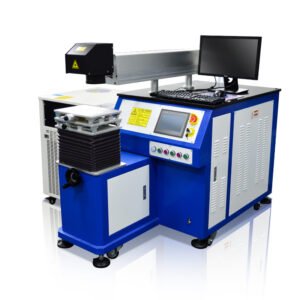
Equipment features
Localized repair welding for molds
The HODA HD-WY mold laser welding machine repairs porosity, local cracks, chipped edges and worn areas on molds. The laser concentrates heat on the defect while filler wire is fused to the base material; the rebuilt area is then finished by grinding, EDM or machining to restore the surface and size.
Build-Up on the Defect Only
- Filler wire fused layer by layer on porosity, chips and wear
- Weld points planned around the defect shape and finishing allowance
Microscope Positioning
- Micro observation of the defect edge, wire tip and target position
- Suitable for mold edges and small repair areas
3D Manual Worktable
- Worktable moves the repair area into the viewing and welding position
- Stable station work for small and medium molds
Adjustable Pulse & Spot
- Pulse width 0.2–20 ms; frequency 0.5–20 Hz; spot 0.2–2 mm
- Parameter space for different repair areas and materials
Fine Filler Wire
- 0.2–0.4 mm wire for 200 W and 300 W; 0.2–0.5 mm for 400 W
- Wire material selected by the mold steel and duty
Links to Finishing
- Grinding, EDM or machining after welding restores the surface
- Target covers both the weld and the finished geometry
Repair samples
Mold repair samples
Localized repair on mold surfaces — the defect, the deposited material and the finished area are assessed stage by stage.
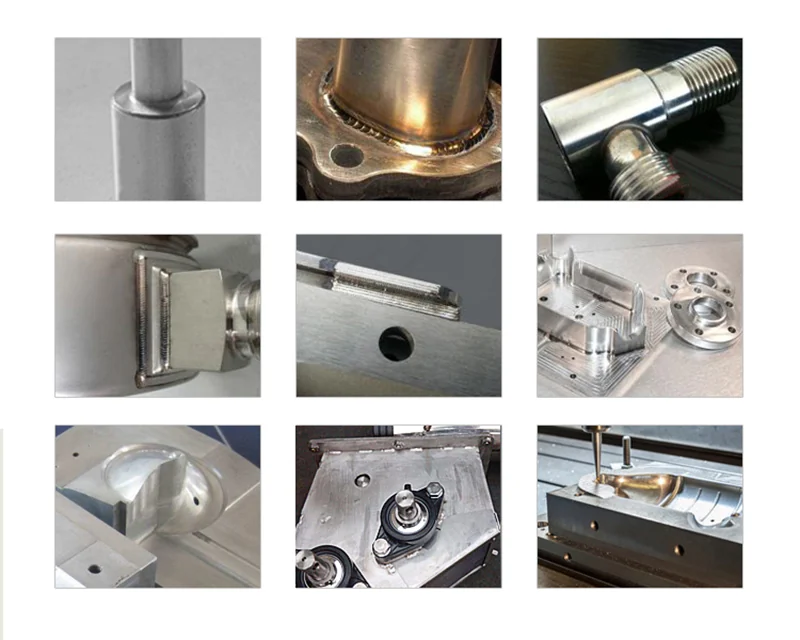
Repair depth and weld results depend on the base material, filler wire and finishing method.
Applications
Where the mold welder fits
For mold makers and maintenance shops that restore repairable areas instead of replacing tools.
If the mold is too large or heavy for the standard station, compare the Large Mold Laser Welding Machine.
Technical specifications
HD-WY series technical parameters
| Models & power | |
|---|---|
| Models | HD-W200Y / HD-W300Y / HD-W400Y |
| Rated laser power | 200 W / 300 W / 400 W |
| Max single-pulse energy | 90 J / 110 J / 110 J |
| Filler wire | 0.2–0.4 mm (200/300 W); 0.2–0.5 mm (400 W) |
| Gross power | ≤7 kW / ≤10 kW / ≤12 kW |
| Laser & processing | |
| Laser type | YAG |
| Wavelength | 1064 nm |
| Pulse width | 0.2–20 ms |
| Pulse frequency | 0.5–20 Hz |
| Spot adjustment | 0.2–2 mm |
| Positioning | Microscope |
| Motion options | |
| Worktable | 3D manual |
| Lifting option | Fixed / 300 mm travelOptional |
| Rotation option | Fixed / 360°Optional |
| Horizontal movement | Fixed / Y-axis / motorized XYOptional |
Motion forms are series configuration options and are not all installed at once. Repair results follow the base material, filler and finishing method — the defect and mold material are confirmed before the process is set.
Materials
Mold steels including S136, SKD-11, NAK80, 718, 738, P20 and W302, plus carbon steel, common alloy steel and stainless steel. Heat-treatment state, service history and defect condition shape the repair method.
Configuration & support
From defect to finished surface
Power options200 / 300 / 400 W by defect size and detail.
Worktable & motion3D manual table; lifting, rotation and horizontal movement by configuration.
Wire selectionFiller matched to the mold steel, heat treatment and duty.
Finishing planGrinding, EDM or machining arranged after welding.
Mold repair test
Send us the defect photos
Share the mold material, defect close-ups, defect size and final surface requirement with HODA. We review the station and process, then confirm a suitable repair configuration.
Product / model: Mold Laser Welding Machine